
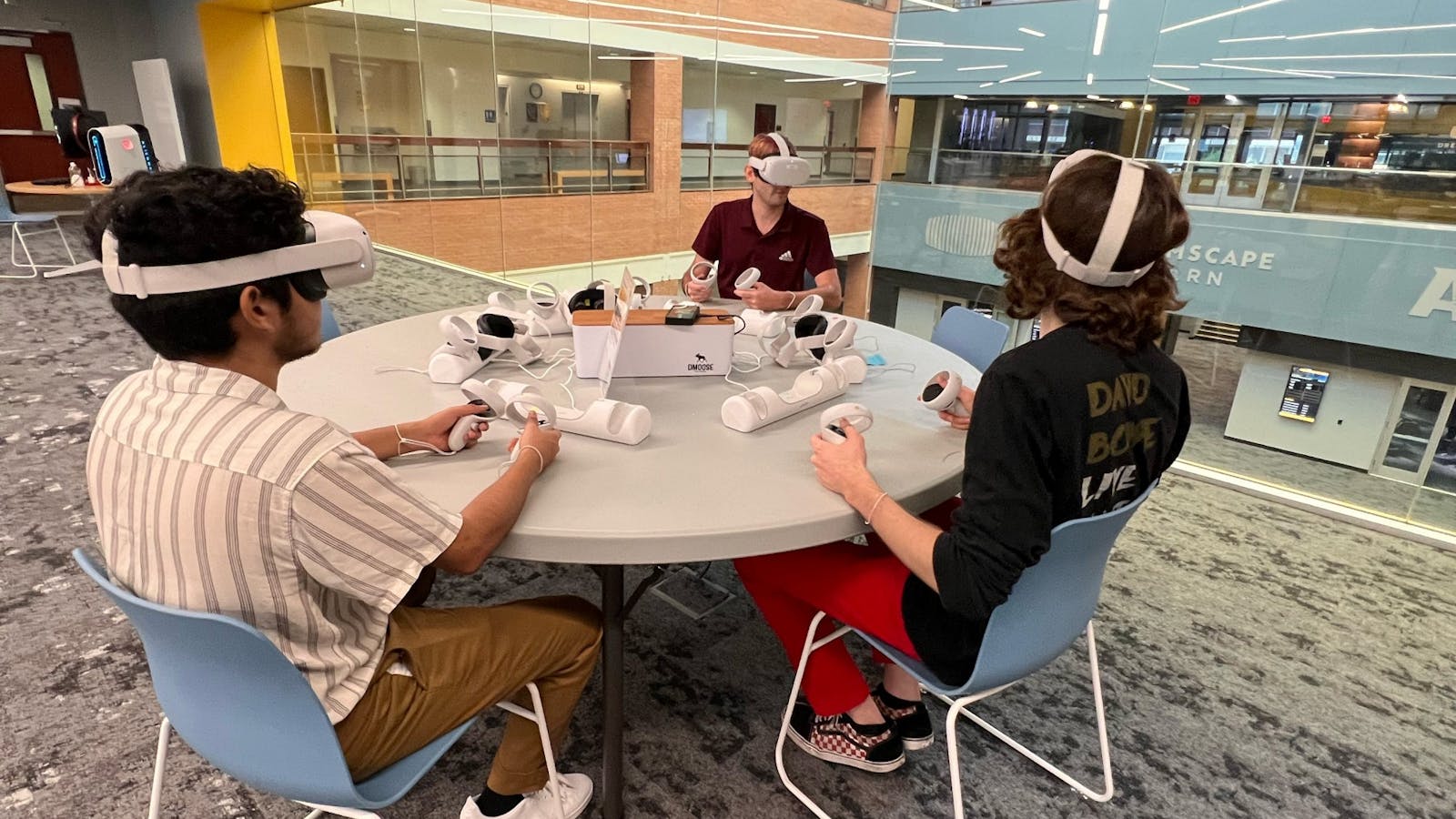
Students at Learning Futures are developing a virtual reality learning space called Huddle that will be tested by an ASU class later this semester. Huddle is an instructor-led virtual learning experience that runs on new mobile technology that will be used as a learning tool.
In Huddle, using VR headsets and controllers, students can interact with virtual objects — such as a piece of coral or a model of water molecules — and their environment to learn about various topics. Huddle allows students to choose their avatars, which look like stick figure characters, and draw 3D objects with a pen tool.
While developing Huddle, the team thought students, many of whom grew up playing video games, would be familiar with Huddle’s video game-like nature, said Dan Munnerley, co-executive director and lead design architect for Next Generation Learning. at ASU.
“Students right now, in the K-12 system, have grown up with things like Roblox, with Minecraft, with gaming, that’s really the way all of us, myself included, have come through,” Munnerley said. “And they learned a lot in that space. So why not continue learning in college now, using the skills they’ve picked up along the way?”
Over the past two years, a student-led team at Learning Futures has developed Huddle, said Toby Kidd, director of Learning Futures Studios.
READ MORE: ASU team develops virtual reality software to teach cross-cultural norms
One of Huddle’s first tests with students outside the team will take place in a few weeks at Learning Futures, located in the Creativity Commons building in Tempe, with students and their instructor from HST 130: The Historian’s Craft, Kidd said.
Huddle can be used in history classes to immerse students in a historical virtual space, such as the trenches of World War I, and allow them to process virtual artifacts from that period, Munnerley said.
“They bring artifacts from history to life in Huddle, where students can really get hold of these bits of history, inspect them closely, pass them along and see them in context,” Munnerley said.
The history class students work in small groups and are led by an instructor who determines which tools and objects the students can see or use. Huddle uses Oculus headsets and controllers and is connected via 5G, a mobile technology that is faster and with fewer delays in transmitting data than previous technology on mobile networks.
The Creativity Commons in Tempe is connected by Verizon 5G Ultra Wideband. Learning Futures is a Verizon 5G Innovation Hub, which means that when used in space, Huddle uses Verizon 5G Ultra Wideband.
“This whole space is being lit with 5G,” Kidd said.
While initial testing will be done on Learning Futures, in the future classes will not need to come to that location to use Huddle because the equipment Huddle runs on is portable and can be brought to the classroom. Next semester, the Huddle team plans to bring its VR learning experience to a Thunderbird School of Global Management classroom, Kidd said.
Some students who have used VR are open to using it in the classroom for instruction. Ernesto Peralta, a freshman studying high school English, said he has played VR video games before and believes VR technology can help people learn both auditory and visual.
“Through VR, you can put them both together in one world,” said Peralta. “You can experience it, you can walk through it. You live what you are taught.”
Huddle will not be the first application of VR as a learning technology for ASU classrooms. Students in BIO 100: The Living World classes do virtual labs in Dreamscape Learn, a VR experience where students learn about ecology and explore an alien zoo.
Learning Futures is developing other VR software, including simulations to teach people the nuances of cross-cultural norms and an interactive, virtual replica of the ASU Tempe campus.
The multitude of areas to which VR is being applied shows the opportunity the technology offers is being embraced, Kidd said.
“Virtual reality is not new,” Kidd said. “This technology has been around for decades, but we’re finally at a point where we can see multiple groups pursuing multiple avenues to deploy immersive technology. And that’s a good thing. That means there’s plenty of work to be done. for people to do and there needs to be a lot of innovation and advancing education using immersive tools.”
For Munnerley, VR technology is a great opportunity for students struggling with traditional ways of learning in school, like himself.
“I think that’s been my motivation to find a platform that works for those people who don’t normally fit into the university model, and to create 3D immersive learning environments that actually engage and excite kids who don’t get those opportunities.” said Munnerley. “I think VR does that, it puts you in control physically. It puts you in different worlds and lets you be in places you could never access.”
Edited by Wyatt Myskow, Greta Forslund and Piper Hansen.
Reach the reporter at kryback1@asu.edu and follow @KadenRyback on Twitter.
Like The State Press on Facebook and follow @statepress on Twitter.

Kaden RybackBusiness and technical reporter
Kaden is a reporter for the Biztech desk, focusing on student-run companies, people profiles, and research papers. During his time at The State Press, Kaden’s biggest piece was about ASU’s history at NASA. He is a sophomore majoring in Journalism and Mass Communication.
Continue to support student journalism and to donate to the State Press today.
0 Comments